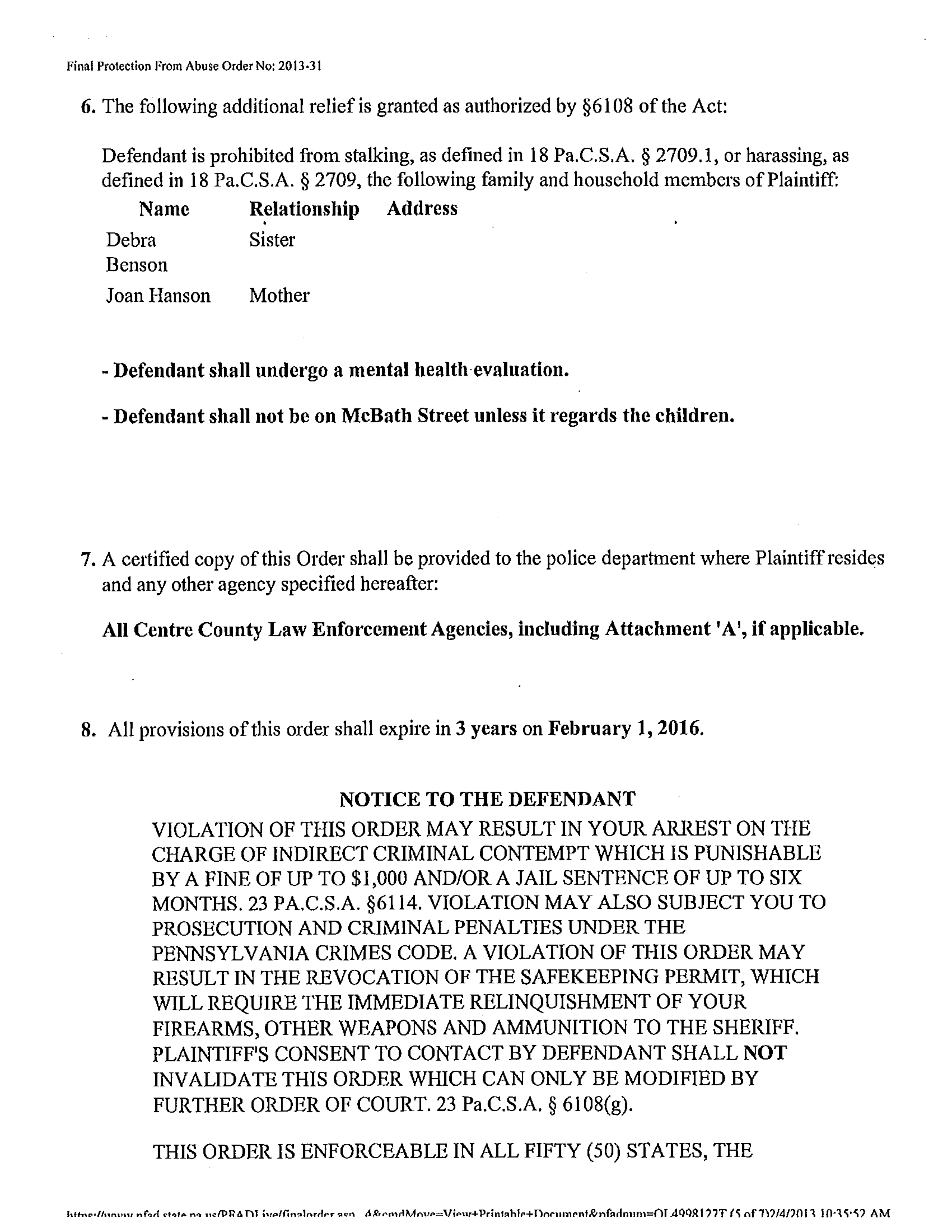
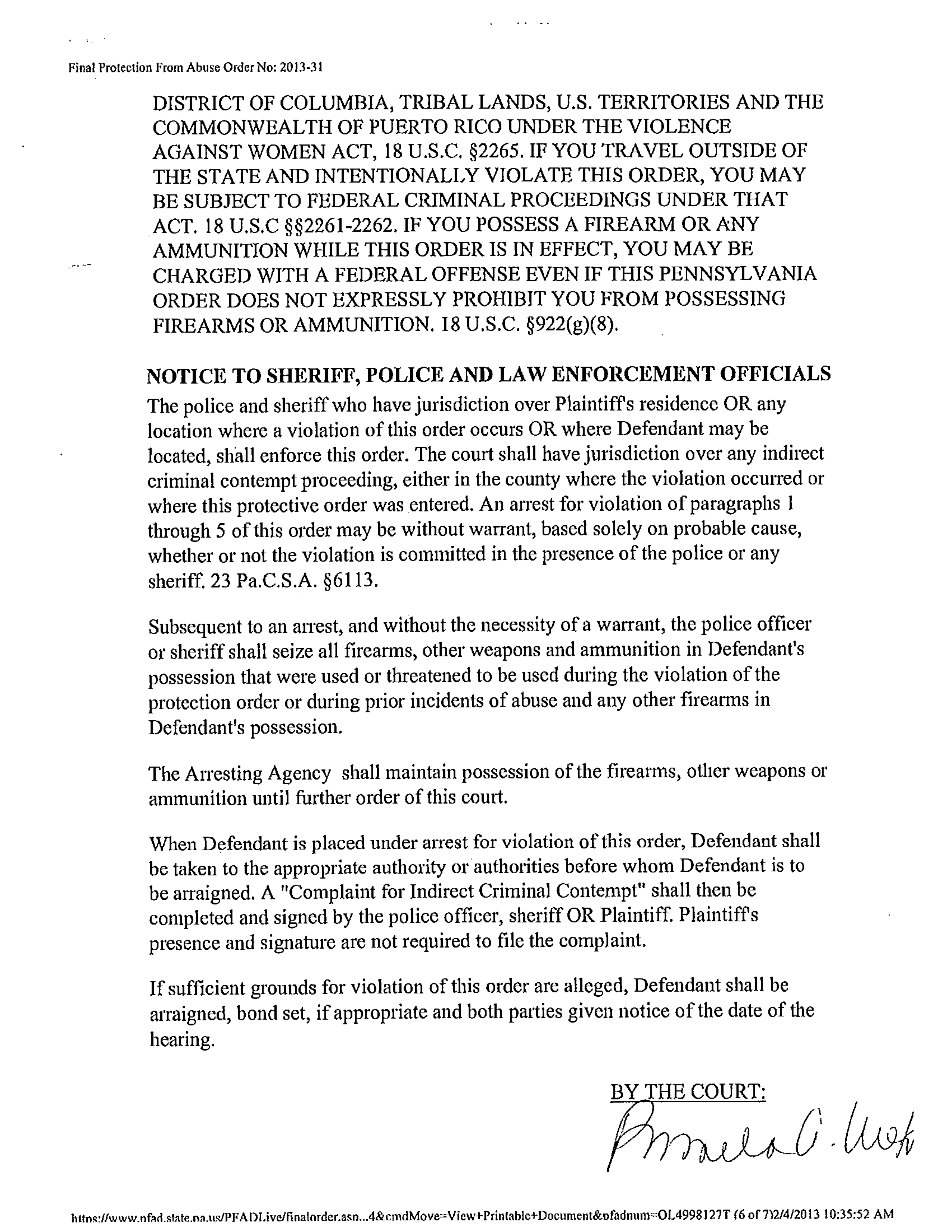
When the hearing finally took place, with me in handcuffs and shackles, I agreed to essentially plead nolo contendreTooltip content and stipulated to the court issuing the order without admitting guilt. Part of my thinking was that since I had never abused Rita and the judge had modified the order to remove the kids and allow me to communicate with Rita about the kids, it would not be a problem abiding by it. I had no idea how easy the order would be to violate unintentionally. I also had no idea at the time it would last for three years.
Gallery 4.2: Final Order
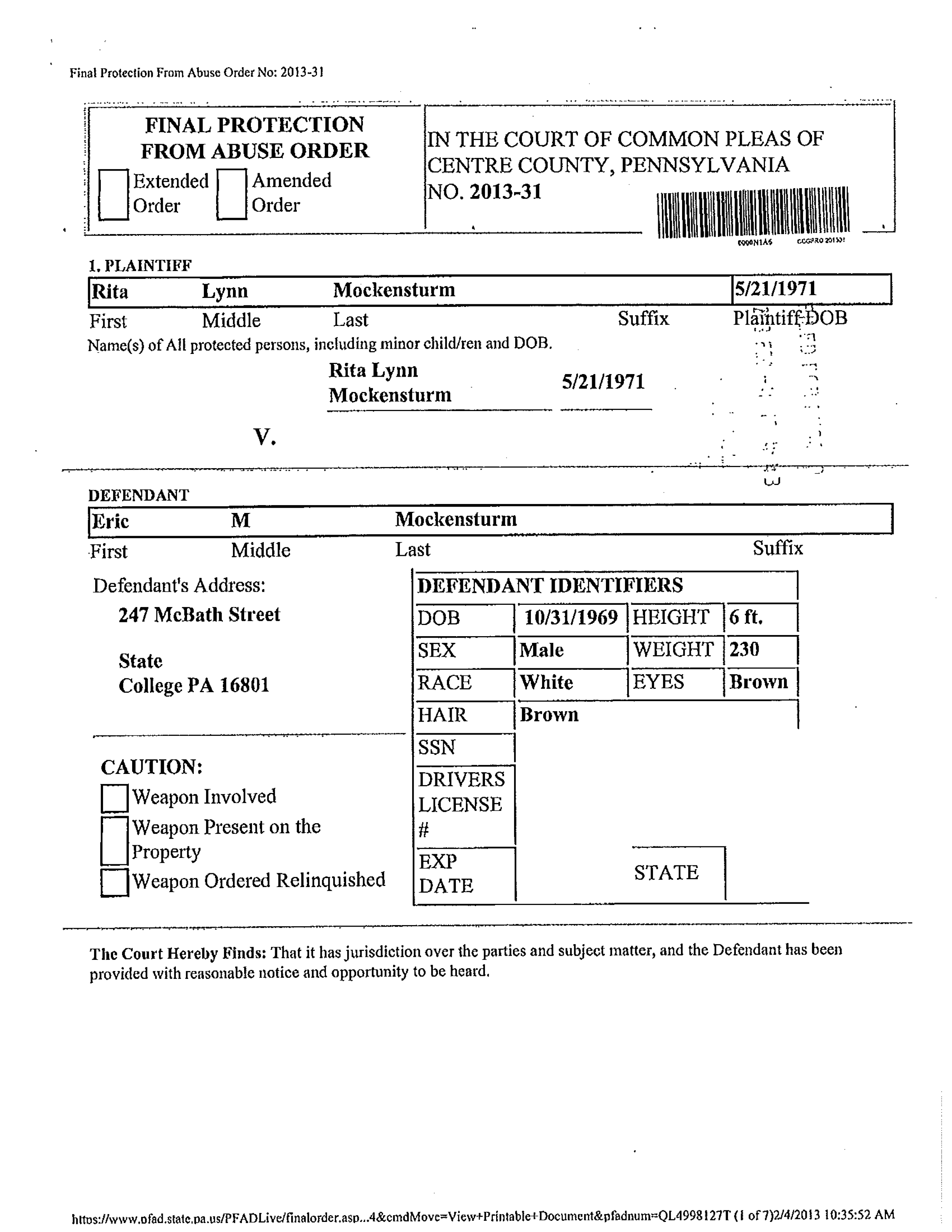
This is a scanned page of a Final Protection From Abuse Order (No. 2013-31) issued by the Court of Common Pleas of Centre County, Pennsylvania. The form identifies Rita Lynn Mockensturm as the plaintiff with a date of birth of 5/21/1971, and Eric M. Mockensturm as the defendant, born 10/31/1969, residing at 247 McBath Street, College PA 16801.
Gallery 4.2: Final Order
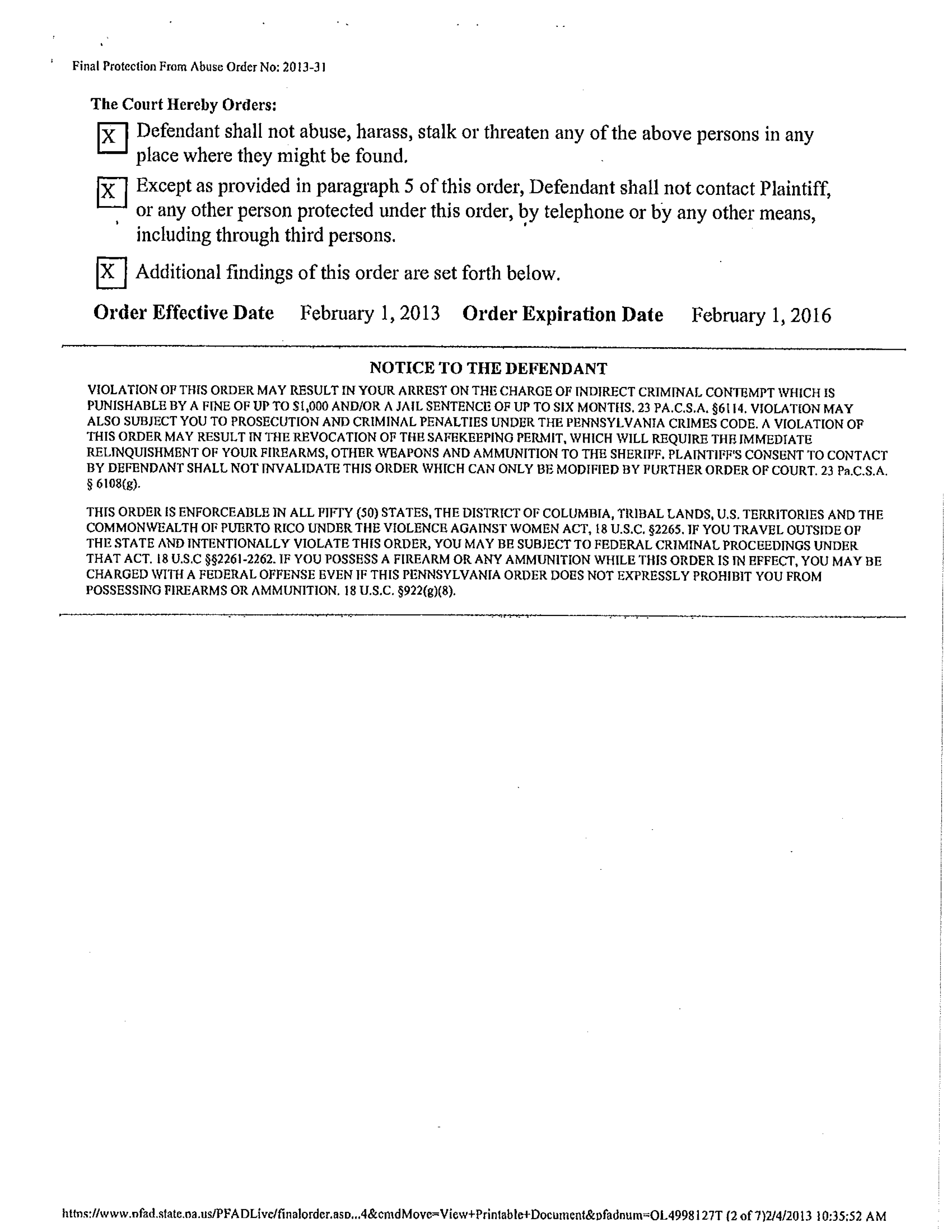
This is a printed legal order from the Pennsylvania Department of Human Services dated February 1, 2013. It includes court directives prohibiting abuse, harassment, stalking, or threats against the plaintiff and protected persons, along with contact restrictions and firearm-related warnings. The document also notes potential federal enforcement under the Violence Against Women Act.
Gallery 4.2: Final Order
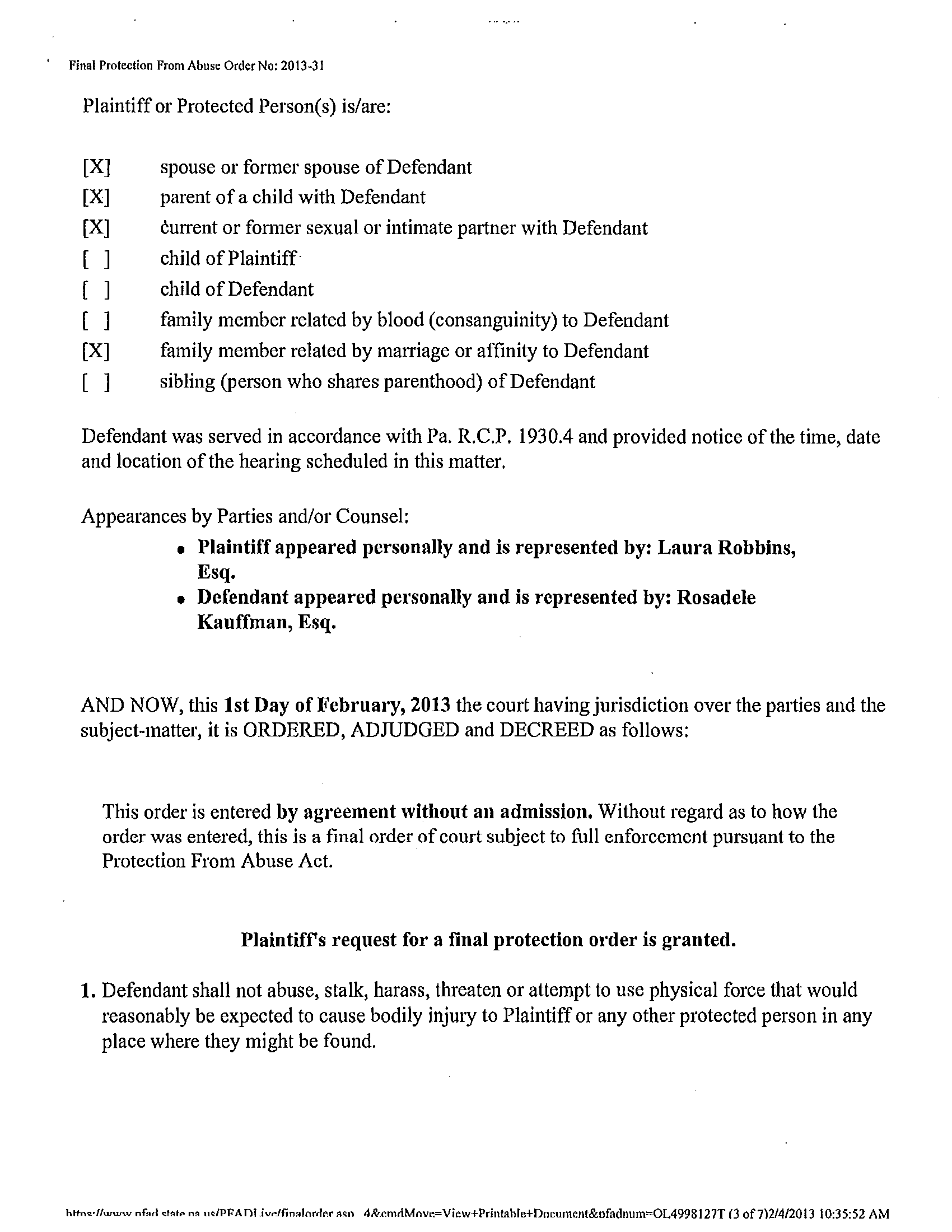
This is a scanned page of a Final Protection From Abuse Order (No. 2013-31) dated February 1, 2013. It lists selected protected persons with checked boxes, notes appearances by counsel Laura Robbins and Rosadele Kauffman, and includes the court's ordered decree granting the plaintiff’s request.
Gallery 4.2: Final Order
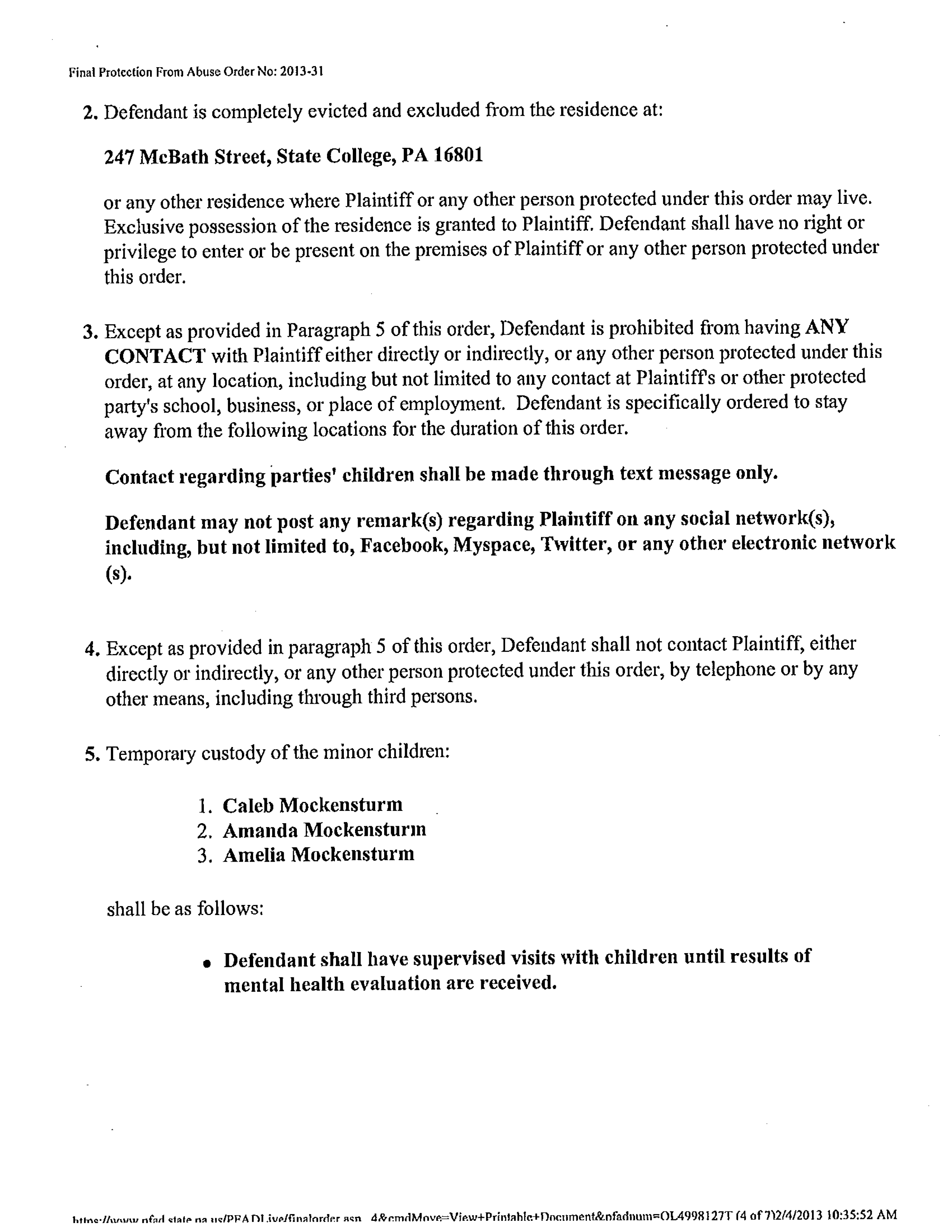
The image displays a printed legal order titled 'Final Protection From Abuse Order No: 2013-31'. It includes numbered paragraphs detailing eviction from a residence at 247 McBath Street, State College, PA; prohibitions on contact with the plaintiff and protected persons; restrictions on social media use; and temporary supervised visitation rights for three minor children named Caleb, Amanda, and Amelia Mockensturm.
Gallery 4.2: Final Order
The image displays the fifth page of a Pennsylvania Final Protection From Abuse Order (No: 2013-31). It includes numbered sections listing prohibited actions, specific individuals to avoid, mental health evaluation requirements, and enforcement details. A notice at the bottom warns that violations may result in arrest, fines up to $1,000, jail time, or revocation of safekeeping permits.
Gallery 4.2: Final Order
The image shows a printed legal document titled 'Final Protection From Abuse Order No: 2013-31'. It includes text regarding federal criminal proceedings under the Violence Against Women Act, notices to law enforcement officials, and instructions for arrest and arraignment procedures. The bottom right contains a handwritten signature under 'BY THE COURT:', with no visible person holding an oversized bank check.
Gallery 4.2: Final Order
This is a scanned legal document titled 'Final Protection From Abuse Order No: 2013-31'. It includes fields for the judge's name (Pamela A. Ruest), date, plaintiff and defendant signatures, and distribution information listing Laura Robbins and Rosadele Kauffman as attorneys.
The final order, issued on February 1, 2013, just as the temporary order expired, is shown in the image gallery. Notable modifications include the removal of my children from the order. However, it seems to make it somewhat less clear who exactly is protected as it includes, in addition to “spouse or former spouse of Defendant,” “parent of a child with Defendant,” “current or former sexual or intimate partner with Defendant,” and “family member related by marriage or affinity to Defendant.” These people obviously could and, in some cases, do include more people than Rita, her mother, and her sister. My understanding for the entire time the order was active was that the court meant to protect Rita and the female members of her immediate family. The court also seemed to interpret the order in this way.
Item 3 was modified to include the clause, “Contact regarding parties’ children shall be made through text message only.” The judge changed the supervised visitation requirement of Item 5 to, “Defendant shall have supervised visits with the children until results of mental health evaluation are received.” The judge replaced all the requirements to pay for Rita’s expenses and court costs in Item 6 with “Defendant shall undergo a mental health evaluation.” and “Defendant shall not be on McBath Street unless it regards the children.”
This final order is an excellent example of how restrictions can be both overly vague and overly narrow, making it difficult for someone to know how a court will interpret them. For example, the “Protect Person(s)” could include the mother of any of the defendant’s children and anyone that had been a sexual partner of the defendant. Fortunately for me, this was irrelevant. Restricting contact with any of Rita’s family did affect me, but it seems like the court took a narrow view of this. Finally, the requirement that I “not be on McBath Street” assumed Rita remained to live on McBath Street for the next three years. I wound up moving back into the house on McBath Street before this order expired. When I asked about getting the order modified, I was told, “Don’t worry about it.” However, after I insisted, we had a hearing to change the order.